


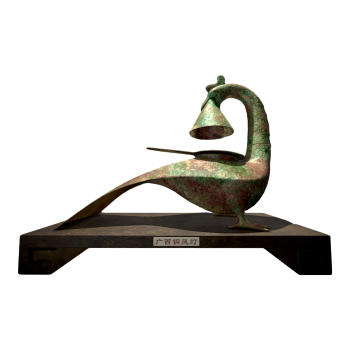
Copper Phoenix Lantern in the Late Western Han Dynasty
In 1971, a pair of bronze phoenix lanterns, 33cm high, 42cm long and 15cm wide, were unearthed in the No. 1 Han tomb bell of the late Western Han dynasty in Guangxi Zhuang autonomous region. their appearance was similar to that of a phoenix bird. they stood side by side with their feet, looked back with their heads raised, and their tails drooped behind them to support the whole body with their feet. they looked very stable. Fengtong body fine carved feathers, head, crown, neck, wings, tail, foot, well-proportioned, clear outline, lifelike. When the lamp is lit, the soot from the wax torch enters the neck through the phoenix's mouth, and the phoenix's abdominal cavity dissolves into the water to eliminate pollution and purify the indoor air so as not to affect human health. It is a product with similar environmental protection function in the earlier period.

Xiaochen Yixi Zun
Xiaochen Yixi Zun is the most well-known Chinese collection in the Asian Art Museum in San Francisco, USA, because many academic books and publications on bronze ware internationally regard it as a symbol of Chinese bronze ware and publish it on the cover of the book. Xiaochen Yixi Zun is one of the famous "Seven Treasures of Liangshan". The objects use realistic techniques and are completely unadorned. The overall shape is seamless, revealing a sense of innocence in the simplicity and richness. This artistic technique of seeing magic in simplicity has always been the highest pursuit of traditional Chinese aesthetics. The inscription describes the Shang king's conquest of the barbarians, and information about this war can also be found in oracle bone inscriptions from the Yin ruins.

Bronze pterosaur from the Warring States period
The vivid sculpture is reflected in its bronze posture, arrogant head posture, and apparent agility of the body. The strong comma shaped tails and their lively clusters, as well as the double rope pattern on the beard, are typical elements of art during the Warring States period. This statue is one of a pair, measuring 17.78 x 20.8 centimeters. This artifact is currently housed in the Minneapolis Museum of Art.

chimes
The large percussion instrument of the Han ethnic group in ancient China, the chime bell, originated in the Zhou Dynasty and flourished during the Spring and Autumn Period and Warring States Period until the Qin and Han Dynasties. China was the earliest country to manufacture and use musical clocks. It is made of bronze and arranged in order of pitch by flat round clocks of different sizes. It is hung on a huge clock stand and struck with T-shaped wooden hammers and long rods, which can produce different musical sounds. Because each clock has a different pitch, striking according to the music spectrum can play beautiful music. Hang a set of copper bells with different tones on a wooden frame, and have the maid strike and play music with a small wooden mallet.

Changxin Palace Lantern of the Western Han Dynasty
The Changxin Palace Lantern of the Western Han Dynasty was unearthed in 1968 from the tomb of Dou Wan, wife of Prince Jing of Zhongshan, Liu Sheng, in Mancheng County, Hebei Province. It was exhibited as an exhibit at the 2010 Shanghai World Expo in China. The body of the palace lantern is a gilded whole, and the palace maid sits with both hands holding the lantern, with a peaceful and elegant expression. The lamp body is 48 centimeters high and weighs 15.85 kilograms. The design of the Changxin Palace Lantern is very clever. The palace maid holds the lantern in one hand and the sleeve in the other hand seems to be blocking the wind, which is actually a rainbow tube used to absorb oil fumes. It not only prevents air pollution but also has aesthetic value. This palace lantern is named after its placement in the Changxin Palace of Empress Dowager Dou (grandmother of Liu Sheng) and is now housed in the Hebei Museum.

Late Shang Dynasty Bronze Cup
This bronze wine vessel is a relic from the late Shang Dynasty (13th century BC to 12th century BC) and is currently housed in the Minneapolis Museum of Art in the United States. This deep boat shaped decanter showcases almost perfect craftsmanship.

Bronze pole top decoration from 12th to 11th century BC
This bronze ware is an ancient Chinese pole top decoration, featuring a combination of four masks on its pointed tip. It was originally decorated at the end of a pole. A powerful taotie (composite animal) mask appears on one side of the top, with a downward facing C-shaped angle. The monster's face formed a mask on the human head; It has a wide nose typical of early masks. On the other side, a ram's head, with its horns pointing downwards, was biting a head resembling a taupe. This artifact can be traced back to the 12th to 11th centuries BC and is now housed in the Minneapolis Museum of Art in the United States.

Fang Ding, now in the collection of the Minneapolis Institute of Art, USA
Fang Ding is an ancient Chinese bronze ware. It is a kind of food vessel with a special shape. The production began in the late Shang Dynasty (11th century BC) in China. Fang Ding played an important role in the social and religious life of ancient China. It is often used as a sacrificial feeding vessel for the worship of gods or ancestors. Fang Ding not only has practical value, but also has artistic value. Its exquisite craftsmanship and exquisite relief patterns show the high technical level of ancient Chinese bronze ware production, and it is one of the precious heritages of ancient Chinese society and culture.

Popular Models

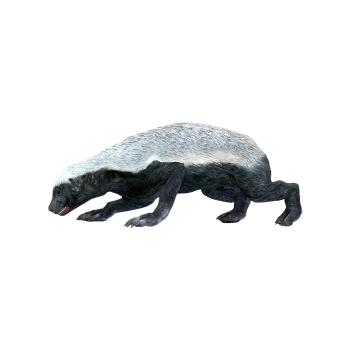
Honey Badger (3D animated model)
192 View
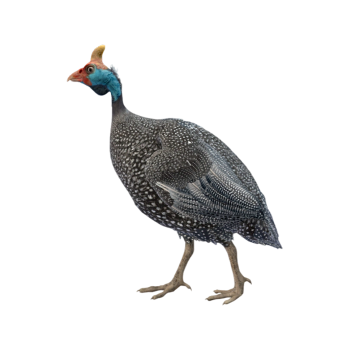
Guinea fowl (3D animated model)
163 View

Wild Goose (3D animated model)
185 View

Red Fox (3D animated model)
153 View
Random Model

Cubic porous skeleton
915 View

Tape Radio 3D Scan
1216 View

Taole Catfish Specimen
498 View

Yamaha TZR 250
1013 View

Vietnam An Lantern
834 View
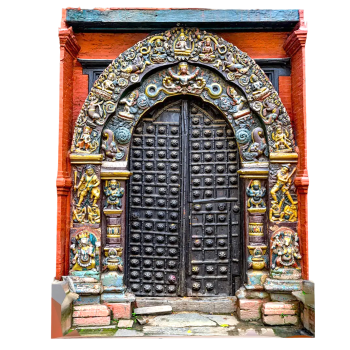

3D model of sperm whale teeth
1004 View


Dodge DF4 Carbon Fiber Racing Bike
705 View
